Showing posts with label Human Rights. Show all posts
2011/10/11
Still A Long Way To Go.. But We'll Get There
After the incidents of Bloody Sunday at Maspero, where the army mercilessly butchered 19 people who did nothing wrong except protest peacefully to be given their basic human rights, the air in Cairo reeks of anger, confusion, desperation and sadness.
The Supreme Council of the Armed Forces (SCAF) has successfully managed over the course of the past seven months (since march 19th, 2011 to be exact, which is in my humble opinion THE turning point in this revolution) to dismantle any sort of threat that might loosen its grip on power. Long gone are the days where all Egyptians stood together as one and protested for the right to scream in the face of tyranny and injustice in middle of winter.
The current political landscape is so polarized that it's almost impossible to find a voice of reason, a middle-of-the-road political movement that can truly represent and be the voice of the non-political, restless, and silent majority who want nothing more than to just live. I won't even bother to mention political parties, they are so insignificant, so amateurish in their message and in their work, so unpopular on the street, so easily played by SCAF, that no one pays attention to them. Many of the so called activists try to rally people around fairly popular slogans of "freedom" and "social justice", but the crudeness of their method (protest, strike, protest, strike, and when all protests and strikes fail to reach critical mass, protest and strike some more) has totally turned people off. They are so caught up in their own political dogma and in the new found fame (dare I say, fortune?) to listen to anyone outside their very small circle. All SCAF had to do to isolate these activists is just let them do their thing, because they are so far off what the overwhelming majority of Egyptians really care about right now, and that is security.
SCAF understood that since day 1, and has successfully managed to paint every political ideology that is any different from what Mubarak's regime had to offer as anti- stability and security. The Islamists? They're fanatics who don't have any respect for human rights or personal freedoms. The liberals? They want Egypt to be a moral black-hole; they desire a decadent society that commits and cherishes every vice known to man. The leftists? They are atheist communists in disguise who want to revive the old Soviet model and try to prey on the poor with promises of an easy life and a classless society. The Copts? They want to build a church on every corner, have connections abroad that want to undermine Egypt's government, and believe that Muslims took this land by force from them, its rightful owners.
Clearly these are all lies, but SCAF is taking full advantage of the decades Egyptians have spent under rulers who made sure that we don't understand or even know "the other". And in the middle of all this confusion, the average Egyptian has gotten away from following political news outside of what he hears at the office's water cooler. I don't think Egyptians are to blame here. In even the most advanced democracies, 98% of the population is politically active only one day in the calendar: election day. This is a fact that SCAF knows all too well and political activists love to ignore. You cannot have a meaningful protest every Friday, much less a meaningful one every day by every union. In the meantime, Egyptians are tired. They are weary. They don't get why all these protests and strikes are happening. They don't understand why Copts are upset. They don't know why things haven't changed for the better after the revolution and frankly, they don't want to know. they're back to their cafe, their soap opera, their work. You go to Heliopolis or Maadi, and life there is so far removed from Tahrir and its action that you might think they exist in a different country, much less the same city.
However, I'm not as upset about all of the above as much as I am about how numb we have become to news about human rights violations. Try to see readers' comments on news regarding new torture allegations against police and army officers, or about a church that was torn down, or a political activists who's summoned before or even jailed by the military judiciary. The comment you see from people who are mostly educated, belong to middle-class and use the internet are nothing short of devastating. Where is our humanity?
One a positive note, things are not that bleak. The revolution is not dead. The street may not be as active as it was back in march, but it's still much better than how it was pre-jan25. But we have to come to peace a few facts:
1- Protests are so yesterday. The worst thing you can do when a protest fails in gathering enough support is to call for another protest soon after to make up for it. There hasn't been a really successful protest at Tahrir since the one on July 8th. Ikhwan (Muslim Brotherhood) and other Islamist groups played it smart since then and a have focused on campaigning instead of protesting. Activists, due to their uncompromising attitude and revolutionary zeal have completely ignored the fact that we're having election in mere months, even threatened boycotting elections altogether, and instead focused on labor strikes and demonstrations in front of key governmental buildings. The results of the activists strategy have been mixed, but never enough to quiet them down or shut them up.
2- SCAF will stay until presidential elections are held. This is simply a fact. I believe they really don't want to rule. That they just want a puppet president. Instead of pushing for moving the elections up the calendar, try to use the time we have to campaign for the upcoming parliamentary elections since they will determine who will end up drafting the constitution. This shouldn't be done via protests because SCAF uses protests as an excuse to judtifying staying longer to maintain a minimal sense of stability (or so the public believes).
3- Get out of your ideological corner and try to reach out to people in the middle. Political parties as well as activists are too comfortable sitting with like-minded people that when you ask each of them what Egyptians want you get a different answer. Islamists think Egyptians go to sleep and wake up with only one thought in their heads: applying Sharia. Liberals would be fooling themselves if Egyptians want unlimited freedom (although limited freedom is no freedom at all, but I digress). Leftists think Egyptians buy their anarchist drivel despite the dozens of Egyptian proverbs that are all about respecting authority, and yes, workers and farmers want authority too. The changes each of these groups want for this country are far too radical to be imposed in an election. Changes to society and the way it behaves come from the bottom up, not from the top down. Therefore, all the fear-mongering should stop. Islamists won't be able to force women to wear veils. Liberals won't force you to wear skimpy clothes. Leftists will probably adopt the very same free market ideas they love to hate if they get to power.
Things are not as bad as they seem. I'm not saying that what happened in the last few days did not deal a major blow to Egypt and its image abroad, but like the saying goes: "What doesn't kill you, makes you stronger." If it wasn't for all the humiliation and suffering and brutality that we endured as a people for decades, we wouldn't have had something as beautiful as jan25. Now is not the time to fold. This is where the going gets tough. I'm sure we're more than up to the task.
2011/09/19
What Egypt Can Learn from Georgia's Police Reform
There is no doubt that when Egyptian activists called for mass protests on January 25th the symbolism of that date wasn't lost on all Egyptians. January 25th is national holiday in honor of the police, where former president Hosni Mubarak usually gave a speech and decorated fallen police officers posthumously. To many, the Egyptian police force was a symbol for all that was wrong with the Mubarak regime: corrupt, brutal and above the law. The death of Khaled Said, who was beaten to death at the hands of two police officers in the street six months earlier was on the minds of many who marched onto Tahrir square on that fateful day. If there was any doubt on how Egyptians felt about the police, such doubts were crushed on the "Friday of Anger" three days later, where in merely four hours the entire security apparatus of the Mubarak regime broke down, leaving the people to fend for themselves against thugs and looters.
After Mubarak's ouster, police reform became a priority in the eyes of most Egyptians, but due to political uncertainty and the incompetence of The Supreme Council of the Armed Forces (SCAF), so far the changes that occured within the ministry of interior has been cosmetic. The fact that the police still operates under the Egyptian emergency law, which has been in effect since Anwar Sadat's assassination and gives the police the ability to imprison any suspects without proper evidence or a trial, is a big concern. Some argue that it is impossible to root out corruption and brutality completely from the Ministry of Interior, and that by doing so there might be a risk of completely losing all sense of security, something that many Egyptians would rather avoid.
States of the former Soviet Union faced a similar problem with their polices forces after the fall of the USSR, and perhaps the most impressive and successful example of police reform took place in Georgia. Of course, it didn't hurt that they now have an elected president, Mikheil Saakashvili, who is Western educated and committed to nation-building and consolidation of liberal democracy.
The first thing they did was to form a new normative base for the ministry of interior according to the principles of international law and human rights protection. Fighting corruption was the priority of the ministry and accordingly a new structural unit was formed. The main aim of this unit is to expose the crimes conducted by state officials, including the representatives of their own unit. In 2005, 120 high-rank state officials are detained and arrested convicted in taking bribes. The Ministry paid special attention to protecting human rights; so it created the Human Rights Protection and Monitoring Main Division, which checks the record and the health condition of suspects, held in temporary detention cells. Since then no fact of mistreatment of prisoners has been reported in the temporary detention cells, which for decades have been a place of torture. The leadership of the Ministry keeps under strict control every violation of human rights by the police officers. After introducing human rights protection mechanism in the Ministry of Internal Affairs many police officers have been penalized for torture and other ill-treatment related crimes. In particular, 4 police officers were arrested, 13 were dismissed from work and 113 were put under investigation for mistreating detainees.
Of course, there can be no reform if the officers themselves weren't committed to reform. Recognizing the necessity of creation of professional and educated staff has attached special attention to the reform of police and security academies. The latter was liquidated and the academy of police was equipped with the newest devices and literature.The system of training and recruiting of police absolutely changed. Starting September 1st, 2005 the MIA together with the Organization for Security and Co-operation in Europe (OSCE) and other donors began realization of the projects of assistance to the Georgian police.
As a result of reforms, 87% of Georgian people have trust in the police (Only the Orthodox Church supasses that number). For comparison, the president's administration gets 57%, the rest of the government 56%. In the past the noted indicator was below 10%. Now a Georgian police officer receives a salary of $ 500-700 (which is higher than the national average), doesn’t take bribes, is polite and punctual.
Stephen Sestanovich, an influential Russia expert at the Council on Foreign Relations wrote on the merits of Georgia’s police transformation and advised Russian President Dmitry Medvedev to follow suit. “Only one political leader in any post-Soviet state has ever attempted this kind of institutional upheaval, and the comparison is an ironic one for Medvedev. For that leader is … Mikheil Saakashvili of Georgia, who soon after becoming president in 2004 fired more than 80% of the country’s police officers…But however awkward the parallel may be, there are lessons in it for Medvedev. Saakashvili’s reform succeeded precisely because it was so radical.”
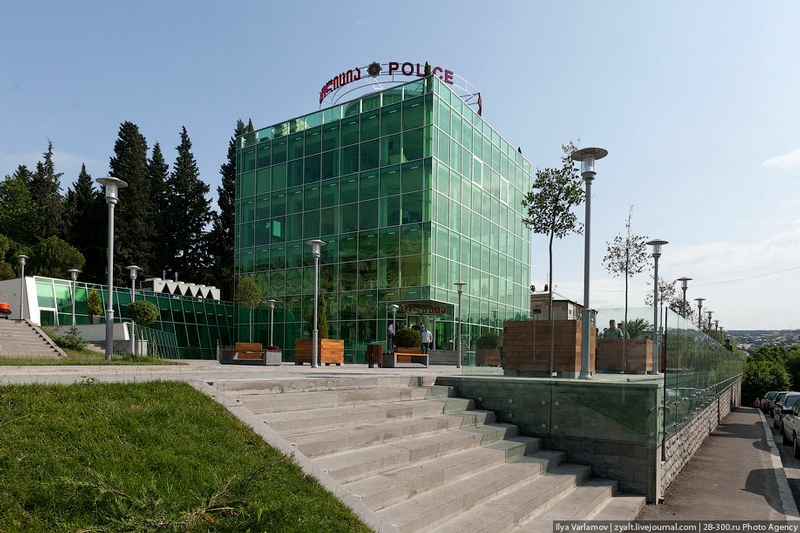
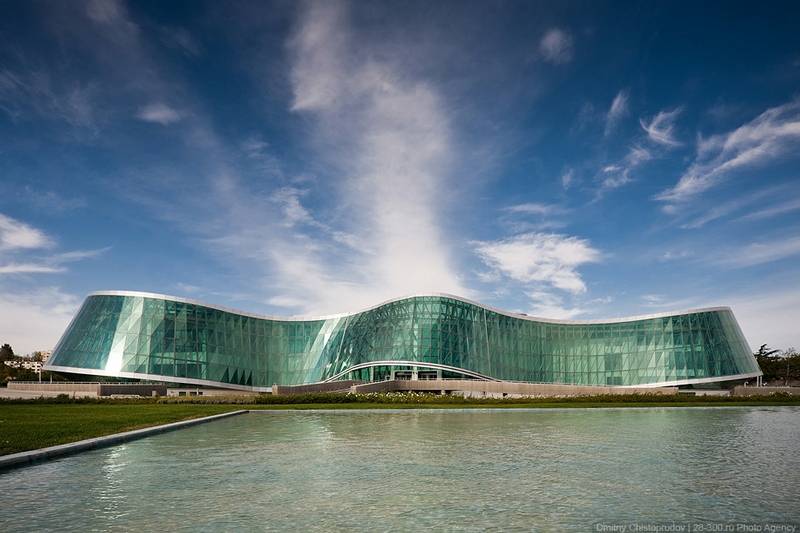
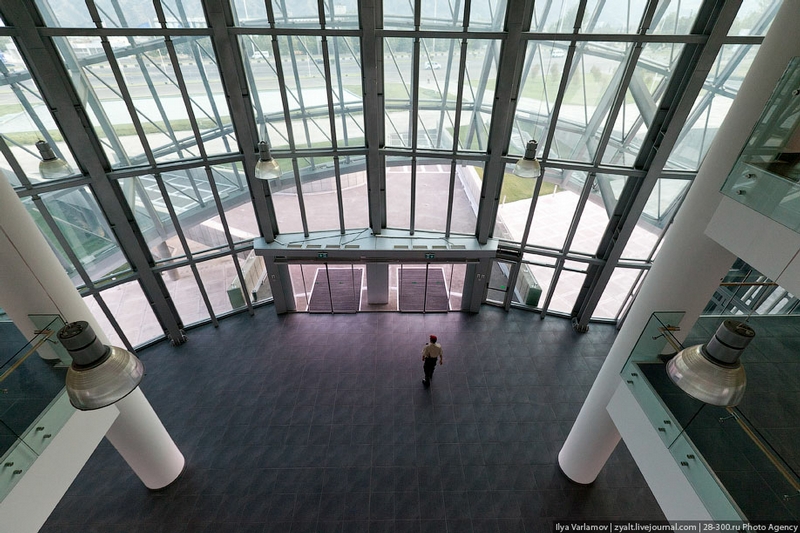
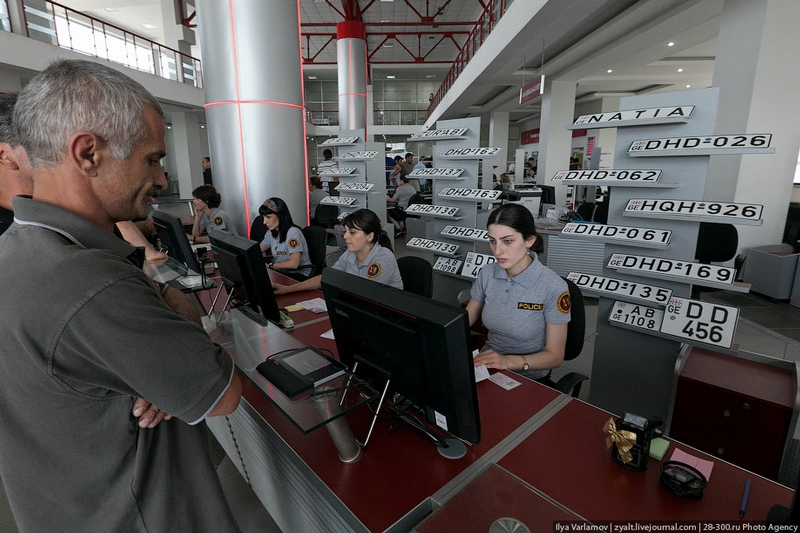
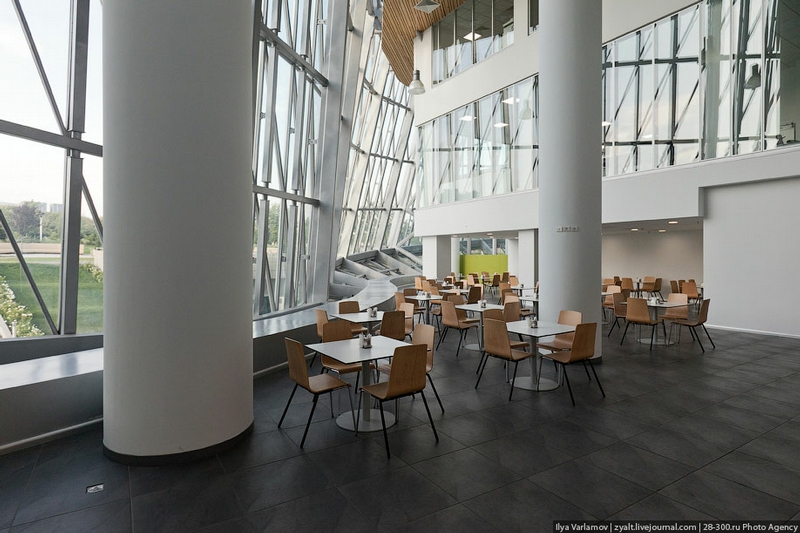
Below are pictures of several police buildings in Georgia. All new police stations are made as transparent as possible so that any passer-by could see what was happening inside.
After Mubarak's ouster, police reform became a priority in the eyes of most Egyptians, but due to political uncertainty and the incompetence of The Supreme Council of the Armed Forces (SCAF), so far the changes that occured within the ministry of interior has been cosmetic. The fact that the police still operates under the Egyptian emergency law, which has been in effect since Anwar Sadat's assassination and gives the police the ability to imprison any suspects without proper evidence or a trial, is a big concern. Some argue that it is impossible to root out corruption and brutality completely from the Ministry of Interior, and that by doing so there might be a risk of completely losing all sense of security, something that many Egyptians would rather avoid.
States of the former Soviet Union faced a similar problem with their polices forces after the fall of the USSR, and perhaps the most impressive and successful example of police reform took place in Georgia. Of course, it didn't hurt that they now have an elected president, Mikheil Saakashvili, who is Western educated and committed to nation-building and consolidation of liberal democracy.
The first thing they did was to form a new normative base for the ministry of interior according to the principles of international law and human rights protection. Fighting corruption was the priority of the ministry and accordingly a new structural unit was formed. The main aim of this unit is to expose the crimes conducted by state officials, including the representatives of their own unit. In 2005, 120 high-rank state officials are detained and arrested convicted in taking bribes. The Ministry paid special attention to protecting human rights; so it created the Human Rights Protection and Monitoring Main Division, which checks the record and the health condition of suspects, held in temporary detention cells. Since then no fact of mistreatment of prisoners has been reported in the temporary detention cells, which for decades have been a place of torture. The leadership of the Ministry keeps under strict control every violation of human rights by the police officers. After introducing human rights protection mechanism in the Ministry of Internal Affairs many police officers have been penalized for torture and other ill-treatment related crimes. In particular, 4 police officers were arrested, 13 were dismissed from work and 113 were put under investigation for mistreating detainees.
Of course, there can be no reform if the officers themselves weren't committed to reform. Recognizing the necessity of creation of professional and educated staff has attached special attention to the reform of police and security academies. The latter was liquidated and the academy of police was equipped with the newest devices and literature.The system of training and recruiting of police absolutely changed. Starting September 1st, 2005 the MIA together with the Organization for Security and Co-operation in Europe (OSCE) and other donors began realization of the projects of assistance to the Georgian police.
As a result of reforms, 87% of Georgian people have trust in the police (Only the Orthodox Church supasses that number). For comparison, the president's administration gets 57%, the rest of the government 56%. In the past the noted indicator was below 10%. Now a Georgian police officer receives a salary of $ 500-700 (which is higher than the national average), doesn’t take bribes, is polite and punctual.
Stephen Sestanovich, an influential Russia expert at the Council on Foreign Relations wrote on the merits of Georgia’s police transformation and advised Russian President Dmitry Medvedev to follow suit. “Only one political leader in any post-Soviet state has ever attempted this kind of institutional upheaval, and the comparison is an ironic one for Medvedev. For that leader is … Mikheil Saakashvili of Georgia, who soon after becoming president in 2004 fired more than 80% of the country’s police officers…But however awkward the parallel may be, there are lessons in it for Medvedev. Saakashvili’s reform succeeded precisely because it was so radical.”
Below are pictures of several police buildings in Georgia. All new police stations are made as transparent as possible so that any passer-by could see what was happening inside.
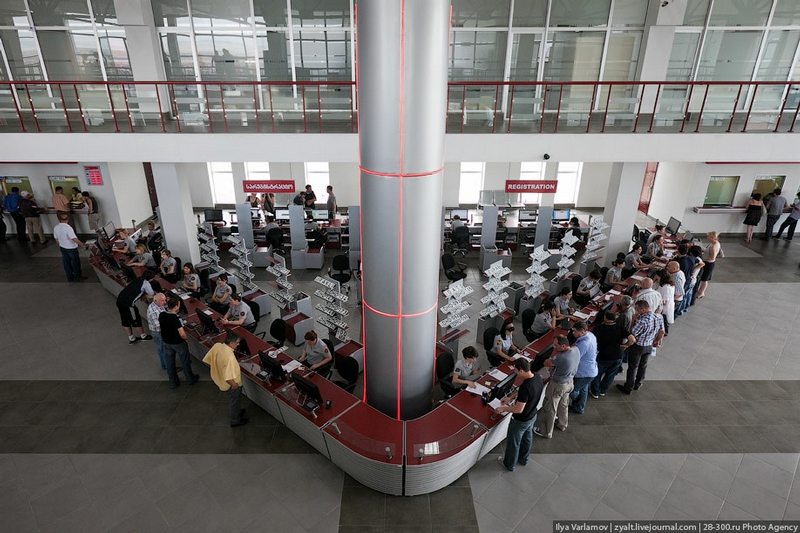
Inside the Georgian DMV. It's shocking how organized it is, isn't it?
How can you be a brutal police officer if this is where you dine?
Sources:
1. Success of Georgia's Police Reform Is A Function of Sovereignty, Jamestown Foundation Blog, April 12th, 2010, http://jamestownfoundation.blogspot.com/2010/04/success-of-georgias-police-reform-is.html
2. Reforms at The Ministry of Internal Affairs, Ministry of Internal Affairs of Georgia, http://police.ge/index.php?m=196&lng=eng
3. Georgian Police Before and After Reform, English Russia, August 20th, 2011, http://englishrussia.com/2011/08/20/georgian-police-before-and-after-reform/
Subscribe to:
Posts (Atom)